
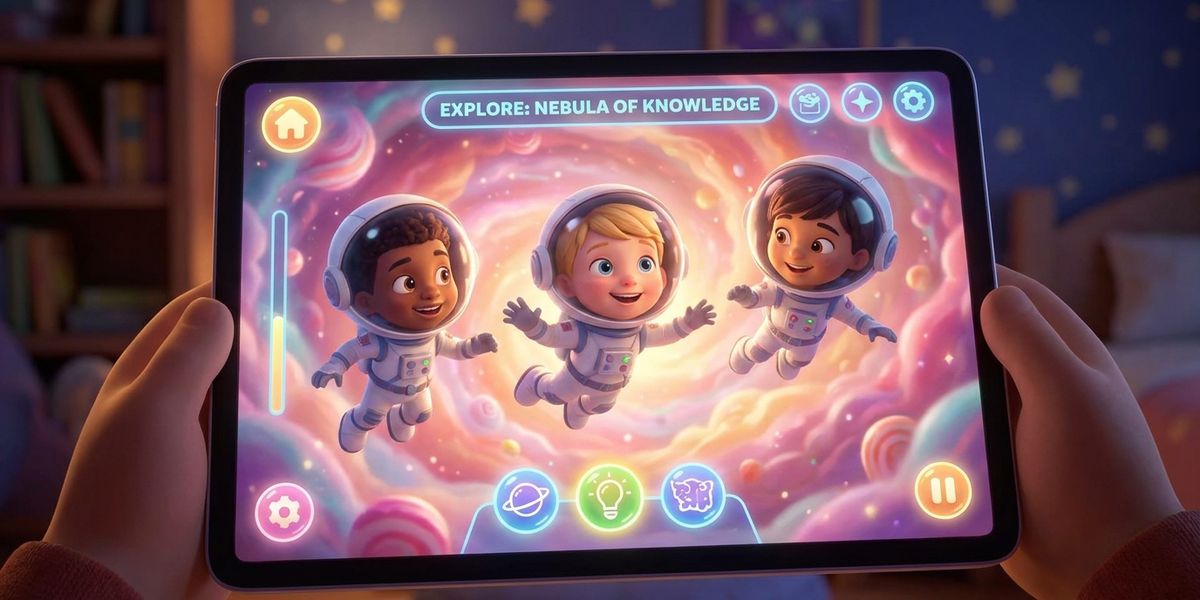
Why ZetaGalaxy Believes Learning Should Feel Like an Adventure
Published: April 18, 2026
Table of Contents
- The Neuroscience of Adventure: Why Kids Learn Better When They Play
- Beyond Flashcards: How ZetaGalaxy Transforms English Practice into a Galactic Quest
- Adventure vs. Drill: The Retention Data Parents Need to See
- A Parent's Guide: How to Get the Most Out of Adventure Learning at Home
- Frequently Asked Questions
Hand a child a worksheet and they'll endure it. Hand them a quest and they won't stop until it's finished.
That difference isn't a matter of effort or discipline. It's how children are wired. The global market for kids' English learning apps is projected to reach $5.8 billion by 2033, and a lot of that growth is being driven by one insight that parents and researchers keep arriving at independently: children absorb language fastest when learning feels like an adventure.
ZetaGalaxy was built around exactly that principle. The platform combines three learning pillars that research consistently backs: Songs that attach vocabulary to melody, Games that turn practice into challenge, and AI Avatars that give children a safe, responsive conversation partner. This piece breaks down why each of those elements works and what the data says about the results.
The Neuroscience of Adventure: Why Kids Learn Better When They Play
Your child's brain doesn't separate fun from learning. In fact, the brain learns better when it's having fun.
A meta-analysis of 43 studies published by Engageli in 2026 found that game-based learning increases knowledge retention by 45% compared to traditional instruction. That's not a marginal difference. That's the gap between a child who vaguely remembers a word from Monday's lesson and one who uses it confidently in conversation by Friday.
Gamification Hub research shows that engagement increases by up to 60% in game-based learning environments. When children are engaged, they're not just sitting still. They're processing, responding, and forming the kind of active memories that stick. Passive listening in a classroom produces a very different neural response than actively trying to win a language challenge.
This is already happening at scale. Studycat data shows that 70% of U.S. children aged 5 to 14 use educational apps. Parents are already reaching for digital tools. The question is whether those tools are built on the science of how children actually learn.
Games and songs both activate the brain's reward system, releasing dopamine when a child succeeds, earns a point, or hears a familiar melody. That dopamine response does two things: it reduces anxiety, and it signals to the brain that the information is worth keeping. Stress, by contrast, raises cortisol levels and actively interferes with memory formation. Adventure learning creates the chemical conditions for retention. Drilling creates the conditions for forgetting.
What adventure-based learning does to the brain:
- Activates the reward system: Dopamine released during game play signals the brain to store and prioritize new information.
- Reduces language anxiety: Low-stakes game environments lower cortisol, making children more willing to attempt and repeat new words.
- Boosts engagement by up to 60%: Higher engagement means more time on task and more language exposure per session.
- Improves retention by 45%: Active, emotionally engaged learning creates stronger and longer-lasting memory traces than passive repetition.
Beyond Flashcards: How ZetaGalaxy Transforms English Practice into a Galactic Quest
ZetaGalaxy doesn't ask children to memorize. It asks them to go on a mission. That shift in framing changes everything about how a child interacts with the English language.
Songs and Melodies
Music is one of the oldest memory tools humans have ever used. Melody creates a retrieval hook that plain text simply doesn't. When a word is embedded in a song, it has rhythm, pitch, and emotional context attached to it, all of which make it easier to recall later.
Talk to Me Boca data shows that learners using gamified tools with music components acquire an average of 45 new words per day. Compare that to traditional flashcard methods, and the difference is stark. Songs don't just teach vocabulary. They teach it in context, with pronunciation, and in a way that children want to repeat.
Interactive Games
A 2024 study on vocabulary acquisition found a 25% improvement in retention among children who learned through interactive games compared to those using conventional study methods. The reason is straightforward: games demand active production. A child can't passively sit through a challenge. They have to respond, which is exactly what language learning requires.
ZetaGalaxy's games are built with clear goals, immediate feedback, and meaningful progress markers. When your child earns a reward for using a word correctly, their brain registers that as a win worth repeating. That cycle is what builds the kind of vocabulary that lasts beyond the next test.
Talk to AI Avatars
Speaking a new language in front of other people is one of the hardest things a child can be asked to do. The fear of getting it wrong in public stops many kids from practicing at all.
A 2025 study on AI chatbots in language education confirmed that conversational AI significantly reduces language anxiety and produces measurable improvements in fluency. When your child talks to a ZetaGalaxy avatar, they're not being graded or judged. They're having a conversation with a patient, responsive character who gives them the time and space to find the right words.
That low-pressure environment is where speaking confidence actually gets built. Children who won't raise their hand in class will talk to an avatar for twenty minutes straight.
ZetaGalaxy's three-pillar approach at a glance:
- Songs: 45 new words per day with music-backed gamified learning, compared to standard memorization methods.
- Games: 25% improvement in vocabulary retention versus conventional study methods (2024 study).
- AI Avatars: Reduced language anxiety and improved fluency through judgment-free conversational practice (2025 study).
Adventure vs. Drill: The Retention Data Parents Need to See
If you're wondering whether adventure-based learning is genuinely more effective or just more enjoyable, the answer is both, and the data is clear.
A meta-analysis published in the Journal of Educational Psychology found that game-based learning produces a 12 to 20% boost in knowledge retention over traditional methods. That range reflects different subjects and age groups, but for language learning specifically, the gains tend to land at the higher end of that window.
A 2025 study on gamified vocabulary tools found that 75% of students reached the highest competency level on vocabulary scales after using them. Three quarters of students hitting the top tier is not a result you can achieve with worksheets and rote repetition.
There's also a common concern among parents worth addressing directly: does educational app use cut into reading time? A 2025 study from Ohio State University found the opposite. Children who used educational apps regularly were associated with more reading time, not less. The engagement habits built through interactive learning appear to carry over into other learning activities.
What the evidence shows when you put adventure learning next to traditional drills:
- Retention: 12 to 20% higher with game-based methods (Journal of Educational Psychology meta-analysis).
- Vocabulary mastery: 75% of students reached the highest competency level using gamified vocabulary tools (2025 study).
- Reading habits: Educational app use is linked to more reading time, not less (Ohio State University, 2025).
- Engagement: Up to 60% higher in game-based environments, meaning children spend more time actively learning per session.
A Parent's Guide: How to Get the Most Out of Adventure Learning at Home
You don't need a big block of time to make adventure learning work. Duolingo's own research into what drives language acquisition points to the same pattern that shows up across multiple platforms: short, consistent daily sessions outperform longer, infrequent ones every time.
Five to ten minutes of ZetaGalaxy per day, built into an existing routine like after school or before dinner, gives your child regular exposure without screen overload. That habit, done consistently over weeks, produces the kind of vocabulary growth and speaking confidence that parents notice.
For families where English isn't the language spoken at home, whether you're in Los Angeles, Toronto, London, or Sydney, the AI Avatar feature is particularly useful. Your child gets a responsive English conversation partner available any time of day, without waiting for a class slot or scheduling a tutor. The avatars are patient, consistent, and never make a child feel slow for needing to repeat something.
ZetaGalaxy's diverse roster of avatar characters also builds something subtler: cultural curiosity. When children interact with characters who look and sound different from them, they start connecting language to people and stories rather than to test scores.
Practical tips for parents starting out:
- Start with 5 to 10 minutes daily: Consistent short sessions build stronger habits than occasional long ones. Pick a time that fits your family's routine and stick to it.
- Let your child pick the avatar: When children choose their own conversational partner, they're more invested in the interaction. That ownership increases the time they spend speaking.
- Use songs as wind-down activities: English songs make great pre-bedtime or post-school activities. The melody keeps the session calm while the vocabulary keeps working.
- Pair digital play with offline conversation: After a session, ask your child to teach you one word they learned. That retrieval practice doubles the retention of what they covered.
- Don't push through resistance: If your child doesn't want to play a specific game, switch to a song or a different avatar. Intrinsic motivation is the engine here. Keep the choice feeling like theirs.
The Adventure Awaits
When learning feels like an adventure, children don't just practice English. They look forward to it. ZetaGalaxy brings together the three elements that research consistently shows produce real language gains: songs that make vocabulary stick, games that demand active thinking, and AI avatars that give children the speaking practice they need without the pressure that holds most of them back. If you want to see the difference for your child, the adventure starts at zetagalaxy.com.
Frequently Asked Questions
Is ZetaGalaxy suitable for kids in non-English speaking countries?
Yes. The games and AI Avatars use visual cues and repetition that work well for beginners. Research confirms that AI chatbots significantly reduce language anxiety, making ZetaGalaxy well suited for children learning English as a foreign language at home.
How does talking to AI Avatars improve speaking skills compared to just watching videos?
Videos are passive. Avatars are conversational partners that respond to what your child actually says. Studies confirm that structured AI conversation provides immediate feedback and scaffolding, improving speaking confidence and fluency much faster than passive watching, especially for shy learners.
How much time should my child spend on ZetaGalaxy daily?
We recommend 10 to 15 minutes a day. Short, consistent sessions produce better retention than longer occasional ones. This aligns with how successful language apps like Duolingo approach daily habit building for early learners.
What age group is ZetaGalaxy best suited for?
ZetaGalaxy is designed for children aged 4 to 10. Content scales from simple vocabulary songs for preschoolers up to more complex conversational quests with AI Avatars for early elementary students in the 7 to 10 range.
How do games and songs help with long-term English retention?
Games trigger emotional memory and reward pathways. Songs attach words to melody, making them far easier to recall. A meta-analysis of 43 studies found that game-based learning increases knowledge retention by 45% compared to traditional methods.