
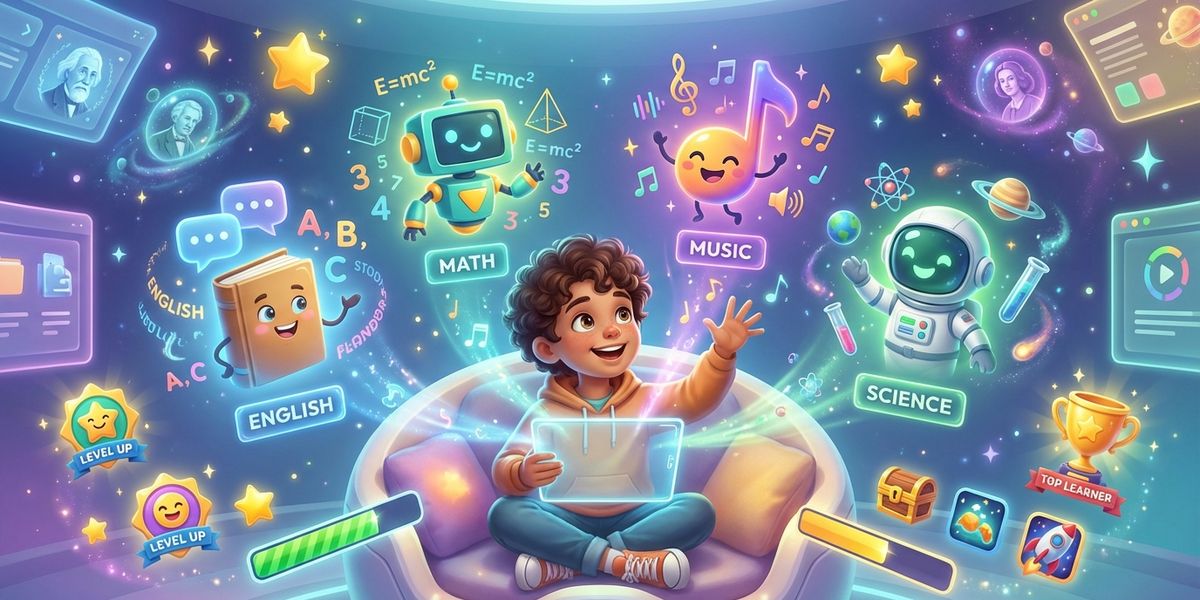
The Rise of AI Tutors: Gamified Learning for Kids in 2026
Published: April 16, 2026
Table of Contents
- Why AI Tutors Are Reshaping Children's Education
- The Science of Play: How Gamified Learning Boosts Language Skills
- Beyond Textbooks: How Songs and AI Avatars Create Immersion
- ZetaGalaxy: Where Games, Songs, and AI Come Together
- Frequently Asked Questions
Something significant is happening in children's education, and it's happening fast. The global AI-powered tutoring bots market is projected to reach $11.89 billion by 2030. At the same time, UNESCO data consistently flags a worldwide teacher shortage that no amount of hiring alone can fix. The gap between the number of children who need quality instruction and the number of qualified teachers available is wide, and it keeps growing.
AI tutors are emerging as a practical, scalable answer to that problem. They don't call in sick. They don't have a class of thirty kids pulling their attention in different directions. And they can give your child real, personalized feedback on their English speaking at 9 p.m. on a Tuesday.
What's making this generation of AI tutors genuinely different from earlier edtech tools is how they teach. Gamification, original songs, and interactive avatars aren't just window dressing. Research shows they're core to why kids actually learn. This piece breaks down the science, the market data, and what it means for your child's English education right now.
Why AI Tutors Are Reshaping Children's Education
The numbers are hard to ignore. The global AI tutors market was valued at $2.11 billion in 2025 and is expected to grow at a compound annual growth rate of 30.5% through 2033. That's not slow, steady growth. That's parents, schools, and education systems voting with their money for a different approach.
UNESCO estimates that the world needs around 69 million more teachers to meet global education targets. The United States faces its own version of this problem. Teacher vacancies are at record highs in many states, and shortages hit hardest in the subjects and communities that can least afford them. For families who want strong English language instruction for their children, the supply simply isn't meeting the demand.
Traditional classroom learning also has structural limits that AI is genuinely designed to work around. A child who's nervous about speaking English in front of classmates won't get much speaking practice in a thirty-person class. A non-native speaker who needs more repetition on a particular sound isn't going to slow down the lesson for everyone else. AI tutors change both of these realities.
Here's what AI tutors can offer that traditional formats simply can't match at scale:
- 24/7 availability: Practice happens when your child is ready, not just when a class is scheduled.
- Personalized pacing: The AI adjusts to where your child actually is, not where the curriculum assumes they should be.
- Judgment-free speaking practice: Children speak more freely when they don't fear embarrassment in front of peers.
- Real-time feedback: Pronunciation errors get corrected instantly, not a week later on a graded worksheet.
- Consistent quality: Every session delivers the same standard of instruction, regardless of the day or the child's location.
For parents of non-native English speakers, this is especially meaningful. A child who grew up speaking Spanish or Mandarin at home can get hundreds of hours of English speaking practice with an AI tutor that never makes them feel slow, behind, or out of place.
The Science of Play: How Gamified Learning Boosts Language Skills
Games aren't just fun. They're one of the most effective learning environments researchers have found for children acquiring language skills.
A published study on the AI-driven gamified speech learning framework (AI-GSLF) found that gamified elements directly improved both motivation and fluency in young learners. Kids weren't just more willing to practice. They were practicing more accurately, for longer, and with measurably better outcomes. The framework incorporated points, progress tracking, and skill-based challenges, and the results showed consistent improvement in spoken English across test groups.
A separate study of the PengTalk platform, an AI-based English learning app, confirmed that gamified features positively impacted student engagement. Children who used gamified versions of the app spent more time on task and showed greater willingness to attempt speaking exercises than those using non-gamified formats.
Then there's the affective filter. This concept from second-language acquisition research describes the psychological barrier that anxiety, self-consciousness, and low motivation create in learners. When a child's affective filter is high, new language doesn't stick. The 'Levelling Up Language Learning' study specifically examined how gamification lowers this filter, reducing anxiety and creating the kind of relaxed, curious mindset where language acquisition actually happens.
Think about what your child does when they're really into a video game. They repeat levels. They try new strategies. They don't quit when they fail. That same psychology, applied to English speaking practice, produces very different results than a workbook drill.
Key benefits that research-backed gamification brings to kids language learning:
- Intrinsic motivation: Rewards and level progression make children want to keep going without external pressure from parents or teachers.
- Repetition without boredom: Games make it natural to practice the same vocabulary or phrase many times because it's embedded in a goal the child cares about.
- Immediate feedback loops: Points lost or earned for a mispronounced word create faster correction than any end-of-week quiz.
- Lower anxiety: A game frame removes the performance stakes. Kids aren't being graded. They're playing, and that distinction matters enormously for a child who's shy about speaking.
- Vocabulary retention: Context-rich game scenarios help words stick far better than flashcard-style memorization.
The research points to one clear conclusion: when learning English feels like playing, children do a lot more of it.
Beyond Textbooks: How Songs and AI Avatars Create Immersion
Ask any adult how they learned the alphabet and there's a good chance they'll start singing. Songs work. They've always worked. Melody, rhythm, and repetition form one of the most reliable pathways for storing language in long-term memory, and cognitive science has explained why for decades.
Multisensory learning, engaging sight, sound, movement, and emotion together, creates stronger and more durable memory than any single-channel input. When a child hears a word in a song, sees it displayed on screen, mouths the sounds, and then uses it in a game, that word is encoded through multiple neural pathways at once. It's far harder to forget.
AI avatars add another layer that's particularly important for speaking practice: social safety. Platforms like Praktika.ai have built their entire product around avatar-driven conversation, where children and adult learners interact with AI characters rather than human instructors. The result is that learners speak more. A lot more. The pressure of being judged by another person disappears entirely.
Buddy.ai, a voice-based AI English tutor, has reached over 20 million students globally. Its success is built on the same principle: children are willing to try, stumble, and try again with an AI character that never sighs, never looks impatient, and never makes them feel behind.
What multisensory AI tutoring delivers that static apps and textbooks simply can't:
- Musical memory encoding: Songs attach English words and phrases to melody, making them significantly easier to recall.
- Avatar personality variety: Different characters give children varied conversational contexts, mimicking real-world speaking demands.
- Zero judgment: An AI character will never make a child feel embarrassed for mispronouncing a word, which is exactly when most kids stop trying.
- Visual and auditory reinforcement: Animated characters mouthing words while audio plays gives children a pronunciation model they can watch and imitate.
- Emotional connection: Children bond with characters. That attachment drives them to return for more sessions, which is where real fluency gets built.
The combination of music, interactive avatars, and responsive AI creates something that looks like play and functions like an immersion environment. That's a difficult thing to build. When it works, though, it produces the kind of natural language acquisition that parents spend thousands of dollars on travel programs trying to achieve.
ZetaGalaxy: Where Games, Songs, and AI Come Together
ZetaGalaxy is a mobile app and web platform built around exactly the elements the research points to: AI avatars, original songs, and skill-based games, all working together to teach English speaking. It's designed for children who are still building their English fluency, whether they're non-native speakers who speak another language at home or native speakers who want to develop stronger expressive communication skills.
The confidence gap is real. Plenty of children understand English far better than they're willing to speak it. That gap between comprehension and production is one of the trickiest problems in language education, and it's almost always rooted in anxiety rather than ability. ZetaGalaxy addresses this directly by putting speaking practice inside a game context where there's no wrong answer, only the next attempt.
What you'll find inside ZetaGalaxy:
- AI avatar tutors: Distinct characters with different personalities give children varied conversational partners so every session feels fresh.
- Original songs for English learning: Music-based lessons make vocabulary and pronunciation stick through melody and repetition.
- Unlimited 21st-century skill games: Game-based activities develop speaking, listening, and comprehension without the feel of a formal lesson.
- Available on mobile and web: Children can practice on a tablet, phone, or computer, fitting English sessions into the moments of a real family schedule.
- Designed for non-native and native speakers alike: The platform builds fluency and confidence for learners at different starting points, not just children who already speak English at home.
For a parent in a city like Chicago, Houston, or Seattle with a child who speaks a different language at home, ZetaGalaxy offers a way to get consistent, high-quality English speaking practice between school days. For a parent whose child is a native speaker but struggles with expressive communication or articulation, the same tools apply in a different direction.
You can find ZetaGalaxy at zetagalaxy.com and download it directly to any mobile device.
Conclusion
AI tutors aren't a replacement for great teachers. They're a solution to the reality that great teachers aren't always available, and that children need far more speaking practice than any single classroom can provide. The research on gamification, multisensory immersion, and avatar-based interaction all points the same direction: children learn English better when they're engaged, anxious-free, and given the chance to practice often. Platforms like ZetaGalaxy are built around exactly these principles, making quality English learning accessible to kids wherever they are.
Frequently Asked Questions
Are AI tutors effective for teaching English to children?
Yes. Studies show AI tutors improve speaking confidence and fluency by providing personalized, real-time feedback in a low-pressure setting. Research on gamified AI learning consistently confirms better outcomes compared to traditional methods, particularly for speaking practice where children often hold back in classroom settings.
How does gamification help with language learning?
Gamification lowers the affective filter, which is the anxiety barrier that blocks language acquisition, increases motivation, and promotes active participation. Research shows it can significantly improve vocabulary retention and speaking accuracy. Children practice more, repeat more, and make fewer mistakes over time when learning is framed as a game.
What is the difference between an AI tutor and a traditional app?
Traditional apps typically focus on vocabulary drills and reading comprehension. AI tutors use speech recognition to simulate real conversations, provide instant pronunciation feedback, and adapt to a child's individual level. The focus is on speaking and listening, not just passive recognition of written words.
At what age can children start using AI English tutors?
Most AI English tutors are designed for children as young as 3 to 4 years old, with content focused on basic vocabulary and simple conversational exchanges. For ages 6 to 12, sessions typically shift toward grammar, sentence structure, and more extended speaking practice appropriate for that developmental stage.
Is ZetaGalaxy suitable for native English speakers?
Yes. ZetaGalaxy helps native speakers refine articulation, expand their vocabulary, and build confidence in expressive communication. Through role-play with diverse AI avatars and interactive games, native-speaking children develop stronger spoken English skills beyond what standard school instruction typically covers.