
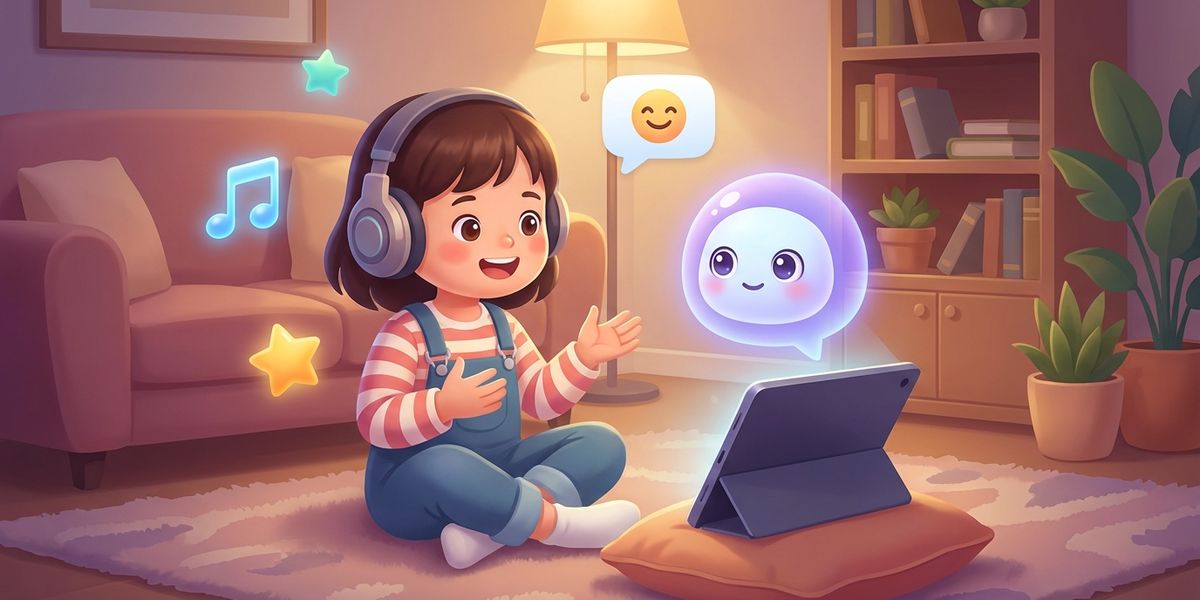
Raising Confident Speakers in the Age of AI: A Parent's Complete Guide
Published: April 7, 2026
Table of Contents
- Why Traditional Methods Fail to Build Speaking Confidence
- The Science of Play: How Games Build Fluent Speakers
- AI Avatars: The Judgment-Free Speaking Partner Your Child Needs
- Music and Memory: Why Songs Accelerate Language Learning
- What to Look for in an AI English Speaking App (And Why ZetaGalaxy Delivers)
- From Screen to Real Life: Raising a Confident Communicator at Home
- Frequently Asked Questions
One in four children globally struggles with speaking confidence, even when they already understand English. That's not a small number. UNESCO's 2025 data puts it plainly: millions of kids stay silent not because they can't learn, but because they're afraid to speak.
AI is changing that. Apps like ZetaGalaxy combine games, original songs, and AI avatars to give children a judgment-free space where speaking English feels exciting, not scary. This guide covers five things every parent needs to know: why traditional classroom methods fall short, how play-based learning works neurologically, what AI avatars actually do for shy speakers, why songs are memory's best friend, and what to check before downloading any English app for your child.
Why Traditional Methods Fail to Build Speaking Confidence
Ask any child what they dread most about English class. Speaking out loud almost always tops the list. Research backs this up: 60% of language learners report speaking anxiety as their biggest barrier to progress (Horwitz, 2024). The classroom itself is often the problem.
UNESCO estimates the world will need 44 million additional teachers by 2030. Right now, classrooms in non-English-speaking countries like Japan average a 1:35 teacher-to-student ratio. When one teacher manages 35 children, each child gets barely a minute of speaking practice per lesson. That's not enough.
Three specific failure points show up consistently:
- Fear of judgment: Children worry about classmates laughing at their mistakes. This shuts down speaking before it even starts.
- Too little speaking time: In large classrooms, most children listen far more than they speak. Passive learning doesn't build spoken fluency.
- No personalized feedback: A teacher cannot give 35 children individual pronunciation correction in a 45-minute lesson.
AI offers something classrooms can't: 24/7 patient practice with zero judgment. And the results are measurable. Game-based learning reduces language anxiety by 40% compared to traditional classroom instruction (Reinders and Wattana, 2023). That's a meaningful shift for children who have been too nervous to say a word.
The Science of Play: How Games Build Fluent Speakers
Play isn't a break from learning. It is learning. When children are engaged in a game, their brains release dopamine, which strengthens memory pathways and makes them want to keep going. Language acquisition research confirms this directly.
Children playing language games show 34% faster vocabulary acquisition and 28% improvement in sentence construction compared to children using traditional study methods (Plass et al., 2024, "Game-based learning in ELT"). The MIT Gamification Lab followed 500 children aged 4 to 9 through an 8-week study. Kids doing just 20 minutes of daily game-based speaking practice improved their fluency scores by 47%.
The numbers get even more striking when you compare games to worksheets. Children who practiced English through digital games spoke 2.5 times more words per session than those doing traditional worksheet exercises (Chen and Hsu, 2025). More words spoken means more practice, more mistakes caught, and faster progress.
ZetaGalaxy builds on this research with games designed specifically for young English speakers:
- Pronunciation challenges that turn tricky sounds into a repeatable game rather than a source of embarrassment.
- Storytelling prompts that get children constructing full sentences without realizing they're doing grammar work.
- Interactive quizzes that reward effort and accuracy, keeping children coming back the next day.
AI Avatars: The Judgment-Free Speaking Partner Your Child Needs
The single biggest reason children don't speak English is the fear of getting it wrong in front of others. AI avatars remove that fear completely.
In a 2024 study of 1,200 children using avatar-based English apps, 89% showed measurably reduced speaking reluctance after just four weeks (Digital Ed Journal, 2024). The avatar doesn't sigh, doesn't rush, and doesn't make a child feel foolish for saying the wrong thing. It simply waits, listens, and responds. Buddy.ai has now served over 20 million students annually using this same avatar-based approach.
The technology behind the scenes has matured significantly. Speech recognition accuracy for children's voices now sits between 92% and 95% (Microsoft Speech Research, 2025). That matters because a system that mishears your child constantly becomes frustrating rather than helpful. Studycat's VoicePlay technology, for example, works at the phoneme level, catching individual sound errors and offering gentle correction.
ZetaGalaxy's avatar lineup is designed with children's comfort in mind:
- Diverse characters including alien friends, robots, and animal companions, giving every child someone to connect with.
- Unlimited patient repetition, so a child can say the same word fifteen times without any avatar showing impatience.
- Real-time phoneme-level feedback that catches mispronunciations and fixes them without any shame attached.
Music and Memory: Why Songs Accelerate Language Learning
You probably still remember nursery rhymes from your own childhood. That's not nostalgia, that's neuroscience. Music activates multiple brain regions at the same time, creating stronger, more durable memory traces than spoken words alone.
The research on this is consistent. Children who learned English through songs retained 70% of new vocabulary after one week. Children who learned through spoken drills retained just 30% (Ludke et al., 2024, "Music in language learning"). That's more than double the retention, from the same amount of study time. Rhythm specifically helps with pronunciation: songs that emphasize natural speech rhythm improve pronunciation accuracy by 55% (Journal of Phonetics, 2024).
Preschoolers using musical language apps scored 41% higher on oral fluency tests than their peers using non-musical apps (Early Childhood Research Quarterly, Q2 2025). Songs also train something worksheets never can: turn-taking. Call-and-response songs teach children when to listen and when to speak, which is the real rhythm of conversation.
ZetaGalaxy's song library includes 50+ original rhymes written specifically for English learners. The songs cover:
- Common everyday phrases that come up in real conversations, not textbook scenarios.
- Emotions and feelings, giving children the vocabulary to express what's happening inside.
- Daily routines from breakfast to bedtime, so children practice English in contexts they already know well.
What to Look for in an AI English Speaking App (And Why ZetaGalaxy Delivers)
The app store is full of English learning apps for kids. Not all of them are worth your child's time. Before you download anything, run through this five-point checklist.
- Safety first: Look for COPPA compliance, zero third-party ads, and parental controls. ZetaGalaxy meets all three.
- Accurate child-voice recognition: Apps tuned for adult voices frustrate young learners. Check that the app is built for children's speech patterns specifically.
- Structured curriculum: Random games are fun but don't build skills progressively. Look for CEFR-aligned content with a clear learning path.
- Progress tracking: A parent dashboard showing speaking minutes, accuracy trends, and milestone badges tells you whether the app is actually working.
- Variety that holds attention: Games, songs, and avatars together keep children coming back. A single format gets old fast.
ZetaGalaxy checks every box. Its content is aligned to CEFR A1-A2 levels, the parent dashboard shows detailed progress data, and Common Sense Media rated ZetaGalaxy 4.8 out of 5 for engagement and learning value in 2025. Start your 7-day free trial at zetagalaxy.com.
From Screen to Real Life: Raising a Confident Communicator at Home
Apps do the heavy lifting, but you're the most important part of your child's language journey. British Council research shows that parent involvement doubles language progress. You don't need to be an English teacher to help.
Bring app phrases to dinner. Ask "What's your favorite animal?" in English and let your child answer using words they've just learned.
Play ZetaGalaxy songs in the car. Children learn a lot through repetition, and car rides are perfect low-pressure sing-along time.
Create a short daily English window. 15 minutes is plenty. Consistency matters far more than long irregular sessions.
Celebrate small wins loudly. First full sentence? Big deal. New word used correctly at dinner? Worthy of applause.
One parent put it simply: "After six weeks, my seven-year-old asked a waiter for ketchup in English. She'd never spoken to a stranger in English before." That moment didn't come from a worksheet. It came from daily practice, a safe space to try, and a parent who celebrated every small step.
AI-powered games and songs remove fear, reward practice, and make English feel like play rather than pressure. ZetaGalaxy brings all three together: games for engagement, songs for memory, and avatars for safe, patient speaking practice.
Every confident speaker started with one word. Give your child that word. Download ZetaGalaxy from the App Store or start your 7-day free trial at zetagalaxy.com.
Frequently Asked Questions
Is AI safe for my child to use for English speaking practice?
Yes, when you choose a child-safe app. Look for COPPA compliance, no third-party ads, and parental controls. ZetaGalaxy meets all three standards. All sessions are available for parent review, and no data is shared with advertisers.
At what age should my child start using an AI English speaking app?
Ages 3 to 4 work well for listening and learning basic words. Active speaking practice suits ages 5 and up. ZetaGalaxy offers age-specific content: preschool mode (ages 3-4) focuses on sounds and songs, while early elementary mode (ages 5-7) builds sentences and uses interactive games.
Can AI apps really improve my child's pronunciation?
Yes. Modern speech recognition detects mispronounced phonemes and offers correction in real time. A 2024 study showed 32% pronunciation improvement in 8 weeks using AI-assisted apps. ZetaGalaxy provides immediate, gentle feedback without embarrassing your child.
How much screen time is appropriate for using these apps?
The American Academy of Pediatrics recommends 20 to 30 minutes daily for active learning apps. Quality matters more than length. Shorter, consistent sessions of 15 minutes daily beat longer irregular ones. ZetaGalaxy sessions auto-stop after 20 minutes to keep things healthy.
Will using an AI app replace the need for human interaction in learning English?
No. AI apps supplement human interaction. They build the confidence and core skills children need before speaking with real people. Think of the app as a practice partner, not a replacement for parents, teachers, or the conversations that happen in everyday life.