How ZetaGalaxy Can Help Kids with ADHD Practice Speaking English
Published: April 2, 2026
Table of Contents
- Why Traditional English Speaking Practice Fails for ADHD Brains
- The Science of Gamification: How Play Unlocks Language Learning
- 5 Ways ZetaGalaxy's Games Transform ADHD English Speaking Practice
- What Makes ZetaGalaxy Different: AI Avatars and Real Conversation Practice
- Building Confidence: From App to Real-World English Conversations
- Frequently Asked Questions
You've tried flashcards. You've sat beside your child and drilled vocabulary. You've played audio tracks during car rides. And yet, when it's time to actually speak English out loud, your child with ADHD shuts down, loses focus, or flat-out refuses. You're not doing anything wrong. The methods are the problem.
ADHD English speaking practice doesn't work the same way it does for neurotypical children. Traditional drills demand sustained attention, delayed rewards, and repetition without feedback. Those are exactly the conditions where ADHD brains struggle most.
ZetaGalaxy is a gamified mobile app where kids talk to AI avatars, sing along to English songs, and play voice-controlled games to build real speaking confidence. It's not a worksheet on a screen. It's a speaking environment designed around how children with ADHD actually learn.
This guide covers five areas: the science of gamification, ADHD-friendly features, AI conversation practice, confidence building, and practical tips you can use starting today.
Why Traditional English Speaking Practice Fails for ADHD Brains
ADHD affects executive function, the set of mental skills that control attention, memory, and impulse management. For English speaking practice, this creates three very specific barriers.
Working memory deficits make it hard to retain new vocabulary long enough to use it in a sentence. Attention challenges mean repetitive drills lose a child's interest within minutes. And the reward system in an ADHD brain needs immediate feedback to stay motivated, which a worksheet simply cannot provide.
Research consistently shows that children with ADHD engage far better with interactive activities than passive ones. Here's how the most common traditional methods fall short:
Worksheets and drills: Require sustained focus with no reward loop. ADHD brains disengage fast.
Flashcards: Build passive recognition, not active speaking. They don't ask your child to say anything.
Group speech therapy classes: Social anxiety and fear of judgment shut many ADHD children down before they attempt a single word.
Passive listening apps: Hearing words is not the same as producing them. Kids tap buttons, but they don't speak.
The gap isn't your child's ability. It's the format. ADHD English speaking practice needs to be active, rewarding, and low-pressure from the very first second.
The Science of Gamification: How Play Unlocks Language Learning
Gamification isn't a gimmick. There's solid neuroscience behind why it works, particularly for children with ADHD.
A 2021 study published in the Journal of Autism and Developmental Disorders found that video modeling activates mirror neurons that directly support speech development in children with attention challenges. When a child watches and then imitates a character speaking, their brain is rehearsing the motor and linguistic patterns required to produce that speech.
Multi-sensory engagement, combining visual, auditory, and kinesthetic input, strengthens memory pathways by up to 40% compared to single-sensory methods. A child who sees a word, hears it spoken, and then says it aloud to advance a game level retains it far longer than one who reads it from a list.
Dopamine is the key to understanding ADHD motivation. The ADHD brain has a dysregulated dopamine system, which means it needs more frequent reward signals to stay on task. Game mechanics, points, level-ups, and character reactions, deliver those signals constantly. Traditional practice does not.
The real-world data backs this up. Speech Blubs, an app using similar gamification principles, reports over 1,000,000 completed speaking activities. Children don't complete a million drills. They complete a million games.
Here's what gamified language learning does that traditional methods can't:
Delivers immediate positive reinforcement after every correct attempt, not at the end of a lesson.
Activates mirror neurons through character modelling, supporting natural speech pattern development.
Engages multiple senses at once, making vocabulary stick in long-term memory.
Creates intrinsic motivation through narrative progress, so kids want to keep going.
5 Ways ZetaGalaxy's Games Transform ADHD English Speaking Practice
ZetaGalaxy isn't built on generic gamification. Every feature maps directly onto what ADHD brains need to stay engaged and make real speaking progress.
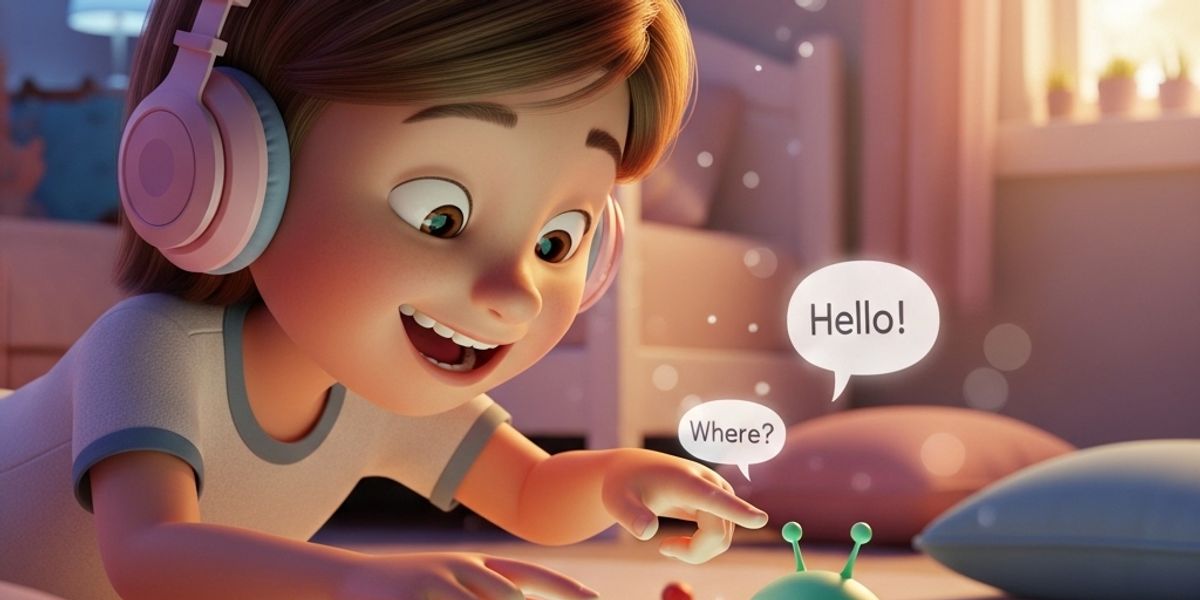
AI avatar conversation. Kids speak to animated characters who respond in real time. This low-pressure social simulation removes the fear of judgment that shuts so many children down in group settings. It mirrors the Conversation Circle methods used by speech-language pathologists and cited in ASHA's 2022 practice guidelines, where structured back-and-forth interaction builds fluency faster than passive input.
Song-based repetition. Music activates different brain regions than speech alone. When vocabulary is embedded in a melody, it bypasses the resistance children feel toward drill-based learning. Kids who refuse to repeat a word ten times will sing it happily twenty times without noticing.
Voice-controlled gameplay. Speaking drives the game forward. Your child doesn't earn progress by tapping a screen; they earn it by saying the word correctly. Children using voice-controlled apps show three times more speaking attempts compared to tap-based alternatives, because every attempt matters to the outcome.
Micro-rewards every 30 to 60 seconds. ADHD brains need frequent, immediate positive reinforcement to sustain attention. ZetaGalaxy's reward loop is calibrated to this window, so your child always feels progress rather than waiting for a gold star at the end of a long session.
Self-paced learning. There's no timer counting down, no classmate moving ahead, no teacher waiting. Children can repeat a phrase five times or fifteen times without frustration or embarrassment. This flexibility reduces performance anxiety, which is a common co-occurring challenge for children with ADHD.
What Makes ZetaGalaxy Different: AI Avatars and Real Conversation Practice
There's no shortage of English learning apps. But most of them are solving a different problem.
BASICS focuses on pronunciation mechanics. Speech Blubs uses video modelling of mouth movements. My Words is a vocabulary flashcard tool. Each has its place, but none of them are built around conversational English practice, which is what actually prepares a child to speak in the real world.
ZetaGalaxy's core feature is interactive AI avatar conversation. Your child doesn't just hear English. They speak it, get a response, and keep the exchange going. That back-and-forth is exactly what builds fluency.
Research from Stanford's Digital Learning Lab in 2023 found that practicing with AI avatars reduces social anxiety by 58% compared to peer conversation. For children with ADHD, who often experience heightened social sensitivity, this is significant. The avatar creates a safe rehearsal space where mistakes feel private.
Children repeat phrases four times more often with avatars than with parents. That's not because parents are doing anything wrong. It's because the avatar removes the emotional stakes. There's no disappointment on its face if a word comes out wrong. Kids will try again and again until they get it right.
This matters especially for families in countries where English conversation partners are hard to find. A child in rural Australia, a non-English speaking home in the US, or a family in India preparing for international schooling can all access the same quality of English conversation practice through ZetaGalaxy, every single day.
Building Confidence: From App to Real-World English Conversations
The goal was never to get your child good at talking to an app. The goal is to get them confident enough to speak with their teacher, their classmates, and the world around them.
Transfer learning from avatar practice to real conversation happens in three stages. Research from Inquiry Island on WH-question development confirms that structured practice with clear prompts improves real conversation quality, not just scripted responses.
Imitation. Your child copies what the avatar says, getting comfortable with the sounds and rhythm of English phrases.
Rehearsal. They begin responding independently within the game, choosing words without being shown exactly what to say.
Application. The phrases from the app start appearing in real life, with teachers, relatives, and friends.
You can speed up this transfer with a few simple strategies at home.
Set a 10-minute daily micro-practice routine. Consistency matters far more than duration. Ten focused minutes every day beats an hour on the weekend.
Use ZetaGalaxy's downloadable conversation cards. Extend practice offline with the same vocabulary your child just used in the app.
Celebrate small wins specifically. Don't just say "good job." Say "you said 'Where is it?' three times today without stopping." Specific praise builds the connection between effort and outcome for ADHD brains.
ESL for ADHD children doesn't need a completely different curriculum. It needs a completely different delivery. When the delivery works with how your child's brain processes rewards and attention, progress stops feeling like a battle.
ADHD presents real challenges for English speaking practice. But those challenges point directly to the solution. ADHD brains need immediate rewards, interactive engagement, low-pressure environments, and multi-sensory input. ZetaGalaxy delivers all four through AI avatars, songs, and voice-controlled games that make practice feel like play.
Download ZetaGalaxy from the App Store or visit zetagalaxy.com to start your free trial today and see what ADHD English speaking practice looks like when it actually works.
Frequently Asked Questions
How much screen time is recommended for kids with ADHD using speaking practice apps?
10 to 15 minute sessions, two to three times daily, work best. Short, focused sessions prevent overstimulation and keep engagement high. ZetaGalaxy's micro-quests are designed specifically to fit within this window.
Can ZetaGalaxy replace professional speech therapy for my child?
No. ZetaGalaxy is a supplemental practice tool, not a replacement for professional therapy. It works alongside clinical intervention, providing engaging daily speaking practice between your child's scheduled therapy sessions.
What age group is ZetaGalaxy designed for?
Ages 4 to 12. The app features adjustable difficulty levels, making it suitable for preschoolers building first words all the way through older children practicing conversational fluency in everyday situations.
How does talking to AI avatars differ from practicing with parents?
AI avatars remove judgment anxiety entirely. Children feel safe making mistakes, repeat phrases without embarrassment, and practice at their own pace, building real confidence before they carry those skills into live conversations.
Is ZetaGalaxy effective for non-native English speaking families?
Yes. ZetaGalaxy is designed for both native and non-native speakers. Clear pronunciation modelling and visual cues help children in ESL households develop natural accent and conversational fluency from the very first session.