
From Screen Time to Speaking Skills: Preparing Kids for an AI-Driven World
Published: April 8, 2026
Table of Contents
- The Screen Time Paradox: From Concern to Opportunity
- Why Games Are the Perfect Vehicle for Speaking Practice
- AI Avatars: A Safe, Engaging Space to Build Confidence
- From Consumption to Creation: The ZetaGalaxy Approach
- Practical Tips for Parents: Maximizing Screen Time for Learning
- Frequently Asked Questions
Every parent has felt it. You hand your child a tablet to buy yourself twenty minutes of peace, and immediately a quiet guilt creeps in. Is this too much? Is this rotting their brain? The screen time debate has been running for a decade, and it's louder than ever.
Here's the thing most parenting articles won't tell you: the screen isn't the problem. What's on it is.
Across the US and other developed nations, kids spend an average of four to six hours a day looking at screens. Most of that time is passive: watching videos, scrolling, consuming without producing anything at all. But a growing body of research shows that screen time can work in a child's favor when it demands active participation, and especially when it builds real-world skills like speaking.
This article breaks down the science behind game-based learning, the role of AI avatars in building speaking confidence, and how apps like ZetaGalaxy are turning passive screen time into active English speaking practice for kids. You'll also get practical, evidence-backed tips you can use right now.
The Screen Time Paradox: From Concern to Opportunity
The official guidance hasn't made this any easier for parents. The World Health Organization recommends no screen time for children under two, and no more than one hour per day for children aged two to four. The American Academy of Pediatrics has shifted its stance slightly over the years, acknowledging that content quality matters just as much as duration. And in 2026, the UK government released findings confirming what many researchers already suspected: not all screen time is equal.
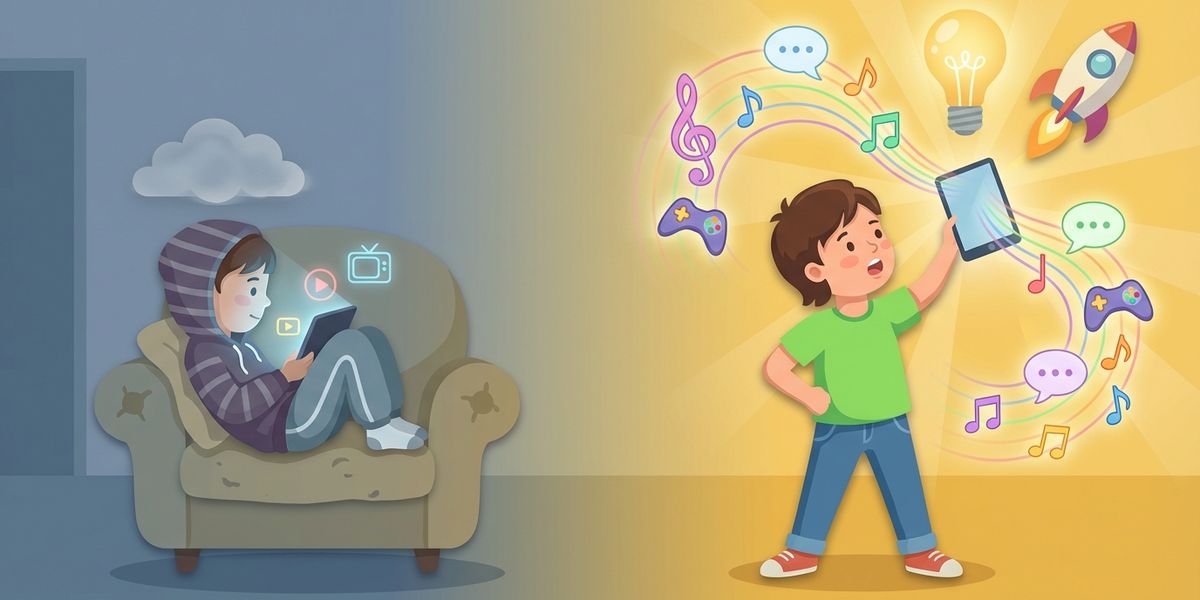
The real distinction is between passive and active screen use. Passive screen time means watching without responding. Active screen time means speaking, choosing, problem-solving, and creating. The gap in outcomes between these two types is significant.
Children with high passive screen use could say around 44 fewer words compared to peers with just five hours of active, quality screen engagement weekly.
That's not a small gap. Forty-four words in a child's early vocabulary can represent weeks of developmental progress. The research points clearly toward one conclusion: what children do on a screen matters far more than how long they're on it. Here's how the two types compare:
- Passive screen time: Watching videos, autoplay content, and background TV. Child absorbs without responding, speaking, or making decisions.
- Active screen time: Games, voice-responsive apps, and interactive conversations where children must speak, choose, and respond in real time.
- Smart screen time: Active screen time with a specific skill-building goal, like speaking practice, tied to immediate feedback and reward loops.
Smart screen time isn't a compromise. It's a completely different category. And that's exactly where games and AI language tools come in.
Why Games Are the Perfect Vehicle for Speaking Practice
Games aren't just more fun than drills. They're structurally better for language acquisition. The reason comes down to how the brain encodes new information.
When a child repeats a vocabulary word from a worksheet, the learning is shallow. When that same word appears inside a game, attached to a goal, a reward, and an immediate feedback signal, the brain processes it across multiple memory systems at once. That's not a theory. It's what the research consistently shows.
A 2025 study conducted in Bogotá found that game-based learning produced measurable improvements in speaking accuracy among English language learners. Children who practiced through games showed stronger pronunciation, better sentence structure, and higher willingness to speak unprompted. A separate study on elementary education confirmed that immediate feedback combined with reward signals is one of the most effective mechanisms for sustaining speaking practice over time.
What makes games work so well for speaking skills specifically?
- Immediate feedback: Children hear whether their pronunciation was correct right away, before bad habits form. This is something a parent or textbook simply can't replicate at scale.
- Emotional engagement: A child who wants to win the next level is a child who will practice one more time without being asked. Motivation is built into the game loop.
- Contextual vocabulary: Words appear inside real situations, like ordering food, greeting a friend, or describing a picture, not on isolated flash cards. Context is what turns passive recognition into active speaking ability.
- Repetition without boredom: Games ask children to repeat phrases across different scenarios and levels, which builds fluency naturally without feeling like a drill.
- Multi-sensory learning: Songs, visuals, voice interaction, and movement cues engage more of the brain simultaneously, which deepens memory retention across all learning styles.
ZetaGalaxy's platform is built around exactly these principles. Songs get kids speaking through rhythm and melody. Games create the reward loop that keeps them coming back. And the talk-to-AI feature puts it all into live conversational practice, which is where real fluency gets built.
The question isn't whether games work for speaking practice. The research has answered that. The question is whether the games your child plays right now are actually designed to build anything at all.
AI Avatars: A Safe, Engaging Space to Build Confidence
Speaking a new language in front of a real person is intimidating for most children. The fear of getting it wrong, of being laughed at, or of not knowing the right word stops many kids from practicing at all. This is one of the biggest barriers to spoken English development, and AI avatars address it directly.
An AI avatar doesn't judge. It doesn't sigh, look away, or correct a child in front of siblings. It waits, responds, and keeps the conversation going regardless of how many attempts it takes. Platforms like Praktika, Buddy.ai, and Ella School have already demonstrated that children who practice with AI conversation partners show measurable reductions in speaking anxiety and greater willingness to attempt new phrases.
The specific advantages of AI avatars for kids include:
- Zero judgment: Children can mispronounce, pause, and try again without any social consequence. This reduces anxiety and increases the number of times a child is willing to practice.
- 24/7 availability: Practice doesn't depend on a tutor's schedule or a parent's availability. When a child is in the mood to practice at 7am before school, the avatar is ready.
- Personalized pacing: AI adapts to each child's proficiency level. A shy five-year-old gets simple prompts. A confident ten-year-old gets more complex conversational challenges.
- Consistent pronunciation modeling: Unlike family members who may have regional accents or their own pronunciation habits, AI avatars model clear, standard English speech every time.
- Safe repetition: Children can repeat the same sentence ten times without anyone losing patience. That repetition is exactly what moves a phrase from short-term memory to natural, automatic speech.
For shy children, second-language learners, and kids who've previously refused to practice speaking out loud, this kind of low-pressure environment changes everything. Confidence built with an avatar carries over into real conversations with teachers, friends, and family.
From Consumption to Creation: The ZetaGalaxy Approach
Most apps give children something to watch or tap. ZetaGalaxy gives them something to say.
The platform combines three core elements: songs, games, and AI conversations. Each one targets a different part of speaking development, and together they create a complete English speaking environment for kids aged 4 to 12.
Here's what the experience looks like for a child using ZetaGalaxy:
Choose an avatar: Kids pick a character they connect with, which immediately creates a sense of ownership and motivation to return.
Sing to learn: English songs introduce vocabulary and sentence patterns through melody. Children absorb pronunciation naturally, the same way they pick up song lyrics without trying.
Play to practice: Voice-controlled games require kids to speak to progress. Saying the right word or phrase unlocks the next level, which makes speaking the game mechanic itself.
Talk to build fluency: Real-time AI conversations put children in real-world scenarios, like meeting someone new, asking for directions, or talking about their day. They get immediate feedback and progress through conversation levels as their confidence grows.
Earn and progress: Points, badges, and level milestones give children a visible record of their progress. That progress is motivating on its own, and parents can see exactly how their child is developing.
The vocabulary isn't abstract either. ZetaGalaxy focuses on practical, real-world language that children can use at school, at the grocery store, or when talking to a friend. Every session produces something a child can actually say out loud in the real world the same day.
Practical Tips for Parents: Maximizing Screen Time for Learning
Even the best app works better with a little parental involvement. Oxford University researchers studying screen time outcomes found that the biggest predictor of positive results wasn't the app itself but whether a parent engaged alongside the child, even occasionally. You don't need to sit through every session. A few simple habits make a real difference.
Choose apps that demand speaking, not just tapping: If your child can complete the entire session without saying a single word out loud, it's passive screen time with a game skin. Look for voice interaction as a core requirement, not an optional extra.
Co-play once a week: Sit with your child once a week and play a level together. Ask questions about the story. Repeat phrases along with them. Research from the University of Oxford consistently shows that co-viewing sessions dramatically improve language transfer from screen to real life.
Set a consistent daily window: Children build stronger speaking habits through daily short sessions than occasional long ones. Fifteen minutes after school is more effective than an hour on weekends. Consistency is what moves words into long-term memory.
Encourage active participation out loud: Ask your child to teach you a word they learned today. Have them explain the game to you in English. This extends the speaking practice beyond the screen and into natural conversation.
Use screen time guidelines as a floor, not a ceiling for quality: The AAP and WHO guidelines set limits for recreational passive use. Active, educational speaking practice is a different category. Focus on what the screen time produces, not just how long it lasts.
The goal isn't to eliminate screens from your child's life. It's to make the time they spend on them count for something real.
Conclusion
Screen time isn't the enemy of childhood development. Passive, purposeless screen time is. When a child is speaking, responding, singing, and practicing real conversations on a screen, they're building one of the most important skills they'll need in an AI-driven world: the ability to communicate with confidence. Games and AI avatars make that practice feel like play. ZetaGalaxy puts it all in one place.
Try ZetaGalaxy for free at zetagalaxy.com and see what happens when your child's screen time actually builds something.
Frequently Asked Questions
What is the recommended daily screen time for kids?
The WHO recommends no screen time for children under two, and under one hour daily for ages two to five. The AAP suggests under two hours of recreational screen time for children aged six to seventeen. Quality and interaction type matter just as much as total duration.
Can games really help kids learn to speak English?
Yes. A 2025 study in Bogotá found game-based learning improves speaking accuracy, pronunciation, and grammar in English learners. Immediate feedback and reward loops make games one of the most effective tools for sustained speaking practice in children.
How do AI avatars make speaking practice less intimidating?
AI avatars remove the social pressure of speaking in front of others. Kids can mispronounce, pause, and try again without embarrassment. This judgment-free environment reduces anxiety and increases the number of times children are willing to practice, which builds confidence gradually.
Is ZetaGalaxy suitable for non-native English speaking families?
Yes. ZetaGalaxy is designed for both native and non-native English learners. AI avatars adapt to different proficiency levels, and clear pronunciation modeling helps children in ESL households build natural conversational fluency from their very first session.
How is ZetaGalaxy different from other language apps for kids?
ZetaGalaxy combines English songs, 21st century skill games, and live AI avatar conversations in a single gamified app. The focus is on real-world speaking practice, not passive listening. Children speak to progress, which makes speaking the core activity rather than an optional add-on.