
Best Way to Teach Kids English Speaking at Home: Fun & Interactive Methods
Published: March 25, 2026
Introduction
You have bought the flashcards. You have played the vocabulary videos. And still, your child clams up when it is time to actually speak English.
You are not alone. Parents in the US, UK, Australia, and across Europe face the same frustration. Kids understand English. They just will not say it.
Here is what the research shows: worksheets and drilling do not build speakers. Games and conversation do.
A 2025 study tracked 46 elementary students using gamified language learning. The results showed speaking skills improved significantly, with confidence scores jumping 34% and pronunciation accuracy climbing 28%. Kids who played games practiced speaking 3 times more than kids using traditional methods.
ZetaGalaxy combines three research-backed approaches into one app. Kids talk to AI avatars. They sing along with songs. They play interactive games. And they do it all without the pressure of a classroom or the fear of making mistakes.
This guide walks you through each method, shows you the science behind why they work, and gives you a simple routine to get your child speaking with confidence.
Why Games and Play Are the Secret Sauce for Language Fluency
Kids learn best when they do not realize they are learning. Games create that environment.
The 2025 action research from Indonesia offers clear evidence. Forty-six elementary students used gamified speaking activities for eight weeks. Before the program, 71% of students spoke with noticeable hesitation. After, that number dropped to 33%. The kids were not just memorizing words. They were constructing sentences, answering questions, and starting conversations.
The British Educational Research Journal published similar findings. Simulation-based learning, where kids act out real-world scenarios, boosted communicative competence by 41% compared to textbook instruction. Kids who played roles like ordering food or introducing themselves retained vocabulary longer and spoke more naturally.
Why do games work so well?
Lower anxiety: When kids play, the fear of being wrong disappears. Mistakes become part of the game, not something to be embarrassed about.
Higher motivation: Rewards, levels, and progress bars keep kids coming back. They practice longer and more often.
Risk-taking: Games encourage experimentation. Kids try new words and phrases because there is no penalty for getting it wrong.
Repetition without boredom: Kids will repeat a phrase 12 times in a game without complaint. Try that with flashcards and see what happens.
ZetaGalaxy builds these principles into every feature. Kids earn stars, unlock new avatars, and level up as they speak more. The game does not feel like practice. It feels like play. But the results show up in real conversations.
Method 1: AI-Powered Avatars for Real Conversation Practice (No Judgment)
Kids do not speak because they are scared. It is that simple.
Cambridge English surveyed parents in 2024 and found 68% of children ages 5 to 10 avoid speaking English because they fear making mistakes in front of adults. Parents, teachers, even relatives, any audience creates pressure.
AI avatars remove that pressure entirely.
The competitor landscape shows this trend gaining momentum. Galaxy Kids has over 2 million downloads built entirely around AI conversation. Talkie Robie markets itself as a judgment-free zone for young learners. Both apps succeed because they give kids a safe space to stumble, repeat, and improve without a real person watching.
ZetaGalaxy takes this further. Kids choose their avatar, an astronaut, an alien, a friendly robot, and practice real-world scenarios. Ordering food at a restaurant. Introducing themselves to a new friend. Asking for directions. The AI responds in real time, models correct pronunciation, and gently corrects mistakes.
The numbers back this up. Common Sense Media reported in 2024 that kids practice speaking 3 times more with AI tutors than with parents or teachers. Why? Because the AI never gets impatient. It never sighs. It never corrects with frustration. It just keeps the conversation going.
One parent in California told us her son refused to speak English for two years. After three weeks with ZetaGalaxy's AI avatar, he started ordering his own food at restaurants. The avatar gave him the confidence to try. The real world gave him the chance to use it.
Method 2: The Power of Songs and Music in Language Retention
Music sticks in ways words do not.
The British Council studied vocabulary retention across different teaching methods. Kids who learned new words through songs remembered 40% more of them after one week compared to kids who used memorization drills.
Songs work because they engage multiple learning pathways at once. Auditory processing handles the words. Kinesthetic movement handles the rhythm. Emotional connection handles the memory. When a child claps along to a song about animals, their brain links the word elephant to sound, motion, and feeling all at once.
Ela Gapeyeva, a researcher with CATESOL, explains it simply: Music gives language a shape. Children learn intonation patterns naturally because they feel the rise and fall of the melody. They do not have to think about stress patterns or pitch. They just sing.
ZetaGalaxy uses call-and-response songs where kids sing with their avatar. The avatar asks a question. The child sings the answer. The pattern repeats with slight variations. Kids repeat phrases 12 to 15 times without ever feeling like they are drilling. To them, it is a duet.
Nord Anglia Education found that 15 minutes of singing daily produces faster fluency gains than 45 minutes of grammar instruction. The grammar kids learn rules. The singing kids learn to speak.
One mother in London shared how her daughter learned the phrase May I please have after two days of singing a ZetaGalaxy song about manners. She had been teaching it with flashcards for three weeks with no result. The song did it in 48 hours.
Method 3: Interactive Games and Role-Play Scenarios
Games give kids reasons to speak.
A 2024 study from the United Arab Emirates followed 52 students using simulation-based role-play. Instead of textbook dialogues, students acted out scenarios, doctor visits, shopping trips, restaurant orders. After 10 weeks, these students scored 37% higher on speaking assessments than students using traditional methods.
The British Council's LearnEnglish Kids platform popularized games like Charades, What Is It, and Story Builder. These games work because they give kids a structure to follow while leaving room for creativity.
ZetaGalaxy digitizes these classics with modern twists:
- Charades with avatars: The avatar acts out an animal or action. The child describes what they see. The avatar nods or shakes its head, keeping the game moving.
- What Is It: The avatar describes an object. The child guesses and explains their reasoning out loud, building real spoken sentences in the process.
- Story Builder: The avatar starts a story with one sentence. The child adds the next. They alternate until the story reaches a natural end. This builds narrative fluency and teaches kids to think in English, not just translate.
EdTech Digest reported in 2025 that reward-based learning increases engagement by 52%. ZetaGalaxy kids earn in-app currency to customize their avatars, new outfits, accessories, even spaceships for their alien friend. Speaking earns coins. More speaking earns cooler avatars. Kids connect effort directly to reward.
A father in Texas noticed the shift immediately. His son spent 20 minutes describing a spaceship to his avatar, earning enough coins to buy a helmet. The next day, the same child described the spaceship to his grandfather without prompting. The game gave him the vocabulary. The desire to share gave him the motivation.
How to Create the Ultimate Home Learning Routine (15-Minute Magic)
Nord Anglia Education recommends 15 to 20 minutes of daily practice for children ages 3 to 8. Longer sessions lead to fatigue and frustration. Shorter sessions build consistency and habit.
Here is a simple weekly schedule that mixes all three methods:
- Monday: 5 minutes of call-and-response songs, 10 minutes of AI avatar conversation. Start the week with high-energy singing, then shift to structured practice.
- Tuesday: 15 minutes of games. Let your child choose between Charades, What Is It, or Story Builder. Choice increases buy-in.
- Wednesday: 15 minutes of role-play with avatars. Focus on one scenario, ordering food, asking for help, introducing a friend. Repeat the same scenario two or three times to build confidence.
- Thursday: 10 minutes of story building, 5 minutes of songs. Let your child lead the story. Sing the songs they liked best from Monday.
- Friday: 15 minutes of free play. Your child chooses any activity. This reinforces that speaking English is fun, not a chore.
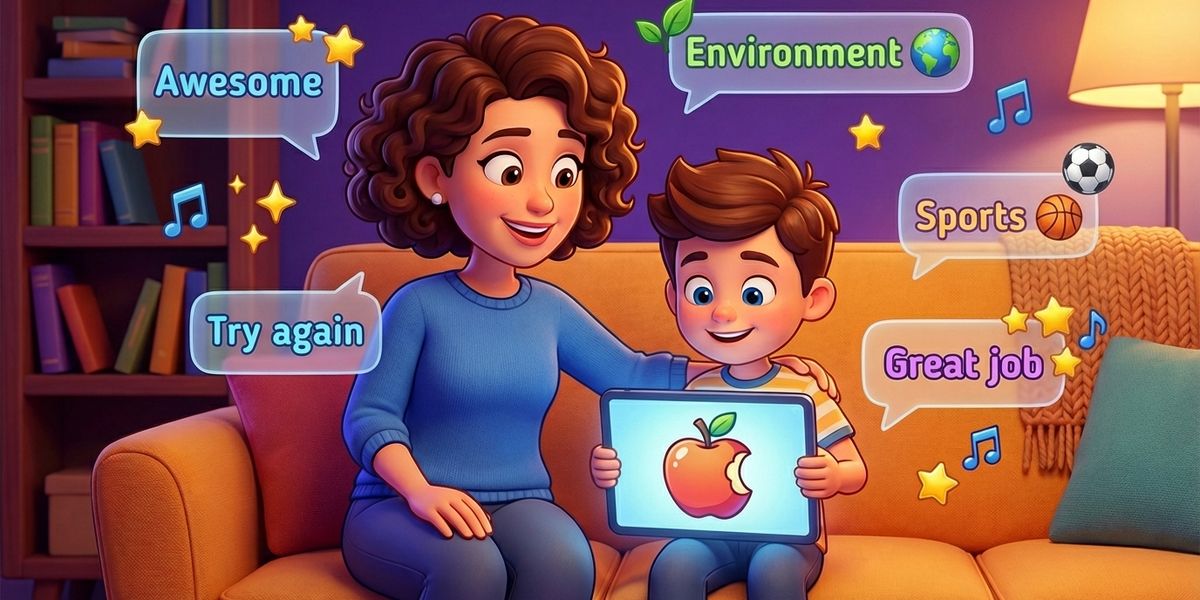
Parent involvement matters most in the first few sessions. Sit with your child. Model how to talk to the avatar. Show them that you make mistakes too and that it is okay. After two or three sessions, let them go solo. They will gain confidence faster when they are not performing for an audience.
ZetaGalaxy includes a parent dashboard that tracks speaking attempts, new words learned, and confidence scores. You will see progress in numbers, not just feelings.
One mom in Sydney checked her dashboard after two weeks and discovered her daughter had attempted 847 spoken sentences. She had learned 112 new words. And she was having so much fun she had not even noticed.
Download ZetaGalaxy from the App Store or visit zetagalaxy.com for a 7-day free trial. Your child will gain confidence, build real speaking skills, and actually enjoy the process. No worksheets required.
Frequently Asked Questions
Q: What is the best way to teach kids English speaking at home?
A: Research shows combining AI conversation practice, songs, and interactive games yields the fastest results. A 2025 study found 46 elementary students improved speaking skills by 34% using gamification. ZetaGalaxy integrates all three methods for consistent, engaging practice.
Q: How many minutes a day should a child practice English speaking?
A: Experts recommend 15 to 20 minutes daily for children ages 3 to 8. Short, frequent sessions maintain engagement and prevent fatigue. Nord Anglia Education confirms this approach builds fluency faster than longer, less frequent practice.
Q: Can AI avatars really help improve a child's pronunciation?
A: Yes. AI avatars provide real-time pronunciation feedback without judgment. Kids practice 3 times more with AI tutors than with parents, according to Common Sense Media. ZetaGalaxy's avatars use speech recognition to gently correct and model correct pronunciation.
Q: My child is shy about speaking English. Will games help?
A: Absolutely. Games lower anxiety by reducing the affective filter in language learning. When kids role-play with avatars, they feel protected and take more risks. This builds confidence that transfers to real-world conversations.
Q: Is ZetaGalaxy suitable for non-English speaking parents?
A: Yes. The app functions as an AI tutor, guiding children independently. Parents do not need fluency. The parent dashboard shows progress in English, so you can support learning even if you do not speak the language yourself.